

Inspection 4.0: Transforming Industrial Inspection with NDT 4.0
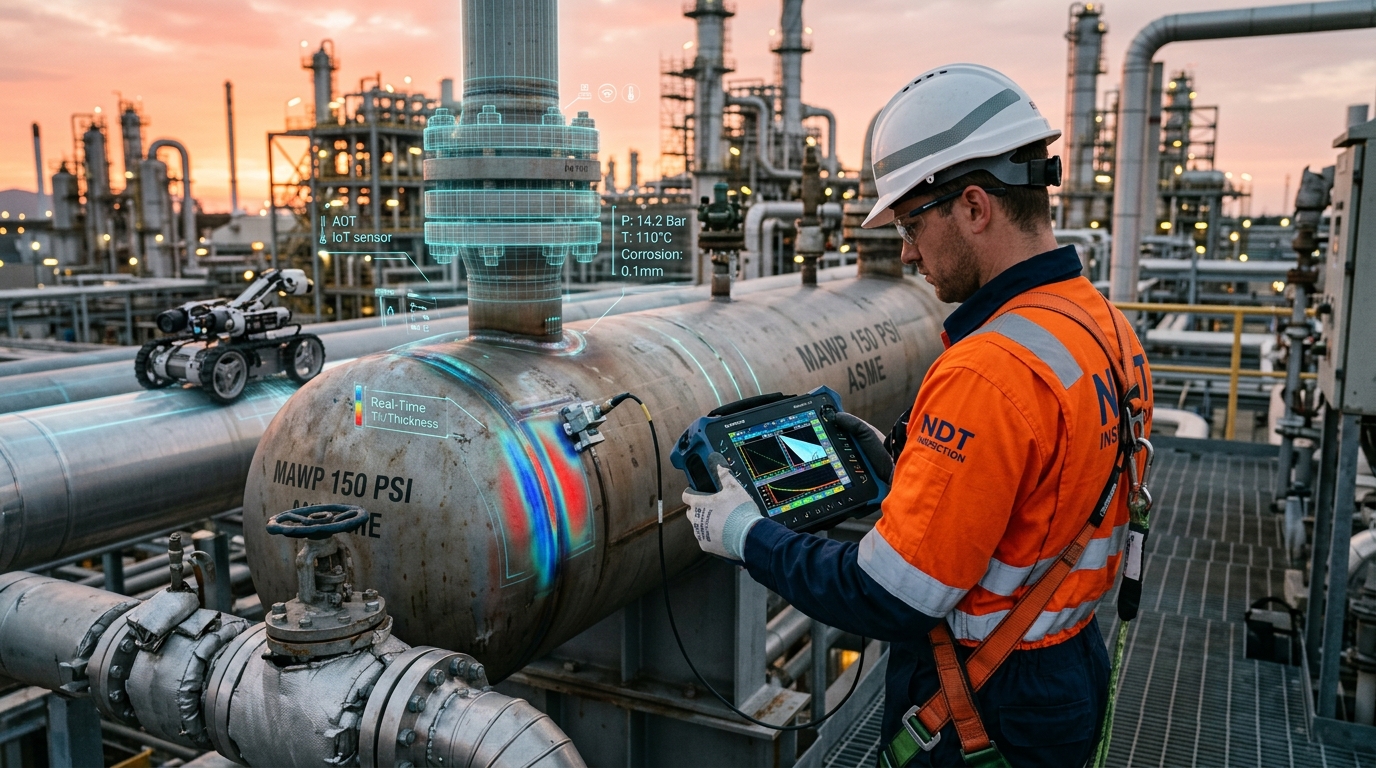
When it comes to industrial asset integrity, inspection is more than identifying defects—it is about turning inspection data into reliable engineering decisions. Nexology supports the transition toward Inspection 4.0, combining established inspection practices with digital technologies, advanced data management, and emerging NDT 4.0 / NDE 4.0 capabilities.
Inspection 4.0 connects inspection activities, data, automation, analytics, and engineering assessment to improve how industrial assets are inspected, evaluated, and managed throughout their lifecycle.
From Traditional Inspection to Inspection 4.0
Industrial inspection has evolved from primarily manual activities toward increasingly connected and data-driven processes.
| Inspection Approach | Key Characteristics |
|---|---|
| Traditional Inspection | Manual inspection, paper-based records, individual test results |
| Digital Inspection | Electronic reports, digital measurements, centralized inspection records |
| Connected Inspection | IoT sensors, cloud-based data, automated data collection, connected systems |
| Inspection 4.0 | Integrated data, advanced NDT, automation, analytics, AI-assisted interpretation, and lifecycle asset intelligence |
The objective is not simply to replace traditional inspection methods. Instead, Inspection 4.0 enhances established engineering practices by making inspection information more connected, traceable, and actionable.
What Is Inspection 4.0?
Inspection 4.0 refers to the integration of digital technologies, inspection methods, data analytics, automation, and engineering knowledge to create a more connected and intelligent inspection process.
It can support the complete inspection workflow:
- Plan — define inspection scope, methods, and priorities.
- Inspect — collect condition and NDT data using appropriate techniques.
- Record — capture results digitally with improved traceability.
- Analyze — evaluate inspection data using engineering methods and advanced analytics.
- Assess — determine asset condition, degradation, and remaining integrity.
- Decide — support maintenance, repair, replacement, or further inspection decisions.
- Monitor — continuously update asset condition information where applicable.
This creates a connection between inspection results and broader Asset Integrity Management (AIM) activities.
What Is NDT 4.0?
NDT 4.0, often discussed more broadly as NDE 4.0, applies Industry 4.0 concepts to nondestructive testing and examination.
Rather than treating an NDT result as an isolated measurement, NDE 4.0 aims to connect inspection methods with digital data, automation, advanced analytics, and intelligent decision support.
NDE 4.0 can involve:
- Digital acquisition and storage of NDT data
- Automated or semi-automated inspection
- Advanced sensing technologies
- Multimodal inspection data
- Artificial intelligence and machine learning
- Robotics and remote inspection
- Cloud and connected inspection systems
- Digital twins and lifecycle asset information
- Improved data traceability and interoperability
NDT 4.0 does not eliminate conventional NDT methods. Techniques such as Visual Testing (VT), Ultrasonic Testing (UT), Magnetic Testing (MT), Penetrant Testing (PT), and Radiographic Testing (RT) remain fundamental inspection methods. Instead, digital technologies can enhance how these methods are performed, recorded, analyzed, and integrated into asset integrity programs.
How NDT 4.0 Enhances Conventional NDT
The evolution toward NDT 4.0 can be illustrated by the way inspection information is handled.
Conventional NDT
A typical workflow may involve:
Inspection → Measurement → Interpretation → Report
The inspection result is often documented as a report or individual data record.
NDT 4.0
A more connected workflow can become:
Inspection → Digital Data → Data Integration → Advanced Analysis → Engineering Assessment → Asset Decision
This enables NDT information to become part of a larger asset information system rather than remaining an isolated inspection record.
Key Technologies Supporting Inspection 4.0
1. Digital Inspection Data
Digital inspection records provide a foundation for Inspection 4.0.
Inspection information can include:
- Inspection locations
- Thickness measurements
- NDT indications
- Photographs and videos
- Equipment identification
- Historical inspection results
- Defect locations
- Inspection dates
- Inspector information
- Engineering assessment results
Structured digital records can improve traceability and make historical information easier to compare.
2. Advanced NDT and Automated Inspection
Advanced NDT technologies can provide more detailed information about material condition and discontinuities.
Depending on the application, technologies may include:
- Ultrasonic Testing (UT)
- Phased Array Ultrasonic Testing (PAUT)
- Time-of-Flight Diffraction (TOFD)
- Digital Radiography (DR)
- Eddy Current Testing (ET)
- Advanced Visual Inspection
- Automated scanning systems
The appropriate technique depends on the material, component, defect mechanism, accessibility, inspection objective, and applicable requirements.
3. IoT and Smart Sensors
Connected sensors can provide continuous or periodic information about operating conditions and asset condition.
Examples include monitoring:
- Temperature
- Pressure
- Vibration
- Corrosion-related parameters
- Equipment operating conditions
- Structural response
When properly integrated, sensor information can complement periodic inspection activities.
4. Artificial Intelligence and Machine Learning
AI and machine learning can assist with large volumes of inspection data.
Potential applications include:
- Image and indication analysis
- Pattern recognition
- Anomaly detection
- Data classification
- Corrosion trend analysis
- Predictive analytics
- Inspection data prioritization
AI should be treated as decision-support technology, not as a replacement for qualified inspectors, NDT personnel, engineers, or applicable acceptance criteria.
5. Digital Twins
A digital twin can connect physical asset information with a digital representation of the asset.
Inspection data can potentially be associated with:
- Equipment geometry
- Inspection locations
- Historical condition
- Degradation mechanisms
- Operating information
- Maintenance history
- Engineering assessments
This creates a more complete view of asset condition throughout its lifecycle.
6. Robotics and Remote Inspection
Robotics, remotely operated systems, and drones can support inspections where access is difficult, hazardous, or costly.
Potential applications include:
- Storage tank inspection
- Elevated structures
- Large industrial equipment
- Difficult-to-access piping
- Confined or hazardous areas
Remote inspection technologies can reduce exposure to certain hazards while providing additional visual or NDT data when appropriately designed and qualified.
Inspection 4.0 and Asset Integrity Management
Asset Integrity Management depends on reliable information about the condition of equipment throughout its service life.
Inspection 4.0 can help connect:
Inspection Data → Condition Assessment → Degradation Monitoring → Risk Evaluation → Maintenance Planning
For example, historical thickness measurements from a pressure vessel or piping system can be analyzed to identify changes over time.
This information can support engineering evaluations such as:
- Corrosion rate assessment
- Remaining thickness evaluation
- Remaining life assessment
- Inspection interval planning
- Repair or replacement decisions
- Risk-based inspection activities
The final engineering assessment must remain consistent with the applicable design code, inspection standard, regulatory requirement, and asset-specific conditions.
Inspection 4.0 and Risk-Based Inspection
Risk-Based Inspection (RBI) uses information about probability of failure and consequence of failure to support inspection planning.
Inspection 4.0 can enhance RBI by providing more structured and continuously updated inspection information.
For example:
Historical Inspection Data
↓
Condition & Degradation Analysis
↓
Risk Evaluation
↓
Inspection Planning
↓
New Inspection Data
↓
Updated Asset Condition
This creates a feedback loop in which inspection results can contribute to progressively better asset integrity decisions.
Practical Example: Storage Tank Inspection
Consider an aboveground storage tank subject to periodic inspection.
A conventional inspection program may generate:
- Visual inspection results
- Ultrasonic thickness measurements
- NDT reports
- Photographs
- Inspection calculations
- Final certification documentation
An Inspection 4.0 approach can connect these records with historical inspection information.
For example, thickness measurements from multiple inspection campaigns can be digitally organized by inspection location. Engineers can then compare historical results, evaluate corrosion trends, identify areas requiring attention, and support decisions regarding future inspection or maintenance.
When combined with appropriate digital visualization or a digital twin, inspection locations and condition information can also be associated with the physical geometry of the tank.
This does not change the underlying inspection requirements. Instead, it improves how inspection information can be organized, interpreted, and used.
Benefits of Inspection 4.0
When appropriately implemented, Inspection 4.0 can support:
Improved Data Traceability
Digital records can make inspection information easier to track from data acquisition through reporting and engineering assessment.
Better Historical Analysis
Inspection results from different inspection periods can be compared more efficiently to identify changes and degradation trends.
More Efficient Inspection Planning
Integrated inspection information can help organizations prioritize inspection activities based on asset condition and risk.
Enhanced Decision Support
Connected inspection data can provide engineers and asset owners with more complete information when evaluating asset condition.
Improved Reporting
Digital workflows can reduce repetitive data entry and improve consistency in inspection documentation.
Lifecycle Asset Intelligence
Combining inspection, maintenance, operating, and engineering information can create a more comprehensive understanding of asset condition throughout its lifecycle.
Inspection 4.0 Does Not Replace Engineering Expertise
Technology is only one part of modern inspection.
Inspection data still needs to be collected using appropriate techniques, interpreted within the correct technical context, and evaluated against applicable requirements.
Qualified personnel remain essential for:
- Selecting appropriate inspection methods
- Performing or supervising inspections
- Evaluating NDT results
- Assessing indications and defects
- Performing engineering calculations
- Determining acceptance criteria
- Evaluating fitness for service where applicable
- Preparing inspection and certification documentation
The future of inspection is therefore not technology instead of engineering expertise.
It is technology supporting engineering expertise.
Challenges in Implementing Inspection 4.0
Moving toward a connected inspection environment also introduces technical and organizational challenges.
These may include:
- Data quality and consistency
- Different software and data formats
- System interoperability
- Cybersecurity and data protection
- Validation of AI-assisted analysis
- Qualification of automated inspection systems
- Integration with existing maintenance systems
- Workforce training
- Initial implementation costs
- Compliance with applicable standards and regulations
For this reason, Inspection 4.0 should be implemented progressively and according to the organization’s actual inspection requirements and digital maturity.
A Practical Path Toward Inspection 4.0
Organizations do not necessarily need to implement every technology at once.
A practical approach can begin with the fundamentals:
Step 1 — Digitize Inspection Records
Move from fragmented or paper-based records toward structured digital inspection data.
Step 2 — Standardize Data
Use consistent equipment identification, inspection locations, measurement units, terminology, and reporting formats.
Step 3 — Connect Historical Data
Bring previous inspection results together to establish an asset condition history.
Step 4 — Introduce Advanced Inspection Technologies
Where technically justified, incorporate advanced NDT, automated inspection, remote inspection, or smart sensing technologies.
Step 5 — Apply Advanced Analytics
Use data analysis and appropriate digital tools to identify trends, anomalies, and areas requiring engineering attention.
Step 6 — Integrate Asset Integrity Information
Connect inspection results with maintenance, operating conditions, risk assessments, and engineering evaluations.
Step 7 — Progress Toward Intelligent Inspection
As data quality and digital infrastructure mature, organizations can consider more advanced applications such as AI-assisted analysis, digital twins, robotics, and predictive analytics.
Standards, Qualification, and Engineering Control
Digital transformation does not remove the need for recognized inspection standards and qualified personnel.
NDT personnel qualification and certification can be addressed through applicable personnel certification schemes, such as ISO 9712, while inspection activities may also be governed by applicable API, ASME, ISO, national regulations, or other industry-specific requirements.
The specific standard or code depends on the:
- Asset type
- Material
- Inspection method
- Inspection objective
- Industry
- Jurisdiction
- Applicable regulatory requirements
Therefore, Inspection 4.0 should be implemented within, rather than outside, the established framework of engineering standards, inspection procedures, qualification requirements, and regulatory compliance.
The Nexology Approach
At Nexology, we view Inspection 4.0 as an evolution of engineering inspection rather than a replacement for proven inspection practices.
Our approach combines:
- Engineering Expertise
- Standards-Driven Inspection
- NDT and Inspection Technologies
- Digital Inspection Data
- Asset Integrity Assessment
- Regulatory Compliance
- Continuous Improvement
By combining technical expertise with appropriate digital technologies, inspection information can become more structured, traceable, and useful for engineering decision-making.
The objective is simple: to support safer, more reliable, and better-informed asset integrity decisions through modern inspection practices.
Conclusion
Inspection 4.0 represents the next stage in the evolution of industrial inspection, connecting conventional inspection methods with digital data, advanced NDT, automation, analytics, and intelligent decision support.
Within this transformation, NDT 4.0 / NDE 4.0 provides an important pathway for modernizing nondestructive examination while maintaining the technical principles, qualification requirements, and engineering controls that underpin reliable inspection.
For asset owners and operators, the value of Inspection 4.0 is not simply the adoption of new technology. It is the ability to transform inspection data into better traceability, deeper asset insight, and more informed engineering decisions.
Disclaimer
This information is provided for educational purposes only and does not replace applicable codes, standards, regulations, inspection procedures, engineering assessments, or professional judgment. Inspection and NDT requirements should be determined based on the specific asset, service conditions, applicable jurisdiction, and relevant industry standards. Always refer to the latest applicable requirements and ensure inspection activities are performed by appropriately qualified personnel.