

· Nat · Insight · 2 min read
Air Receiver Tank Inspection: Ensuring Safe Operation and Compliance
Explore the critical role of air receiver tank inspections in maintaining pressure vessel integrity, ensuring operational safety, and meeting regulatory compliance requirements based on tank size and operating pressure.
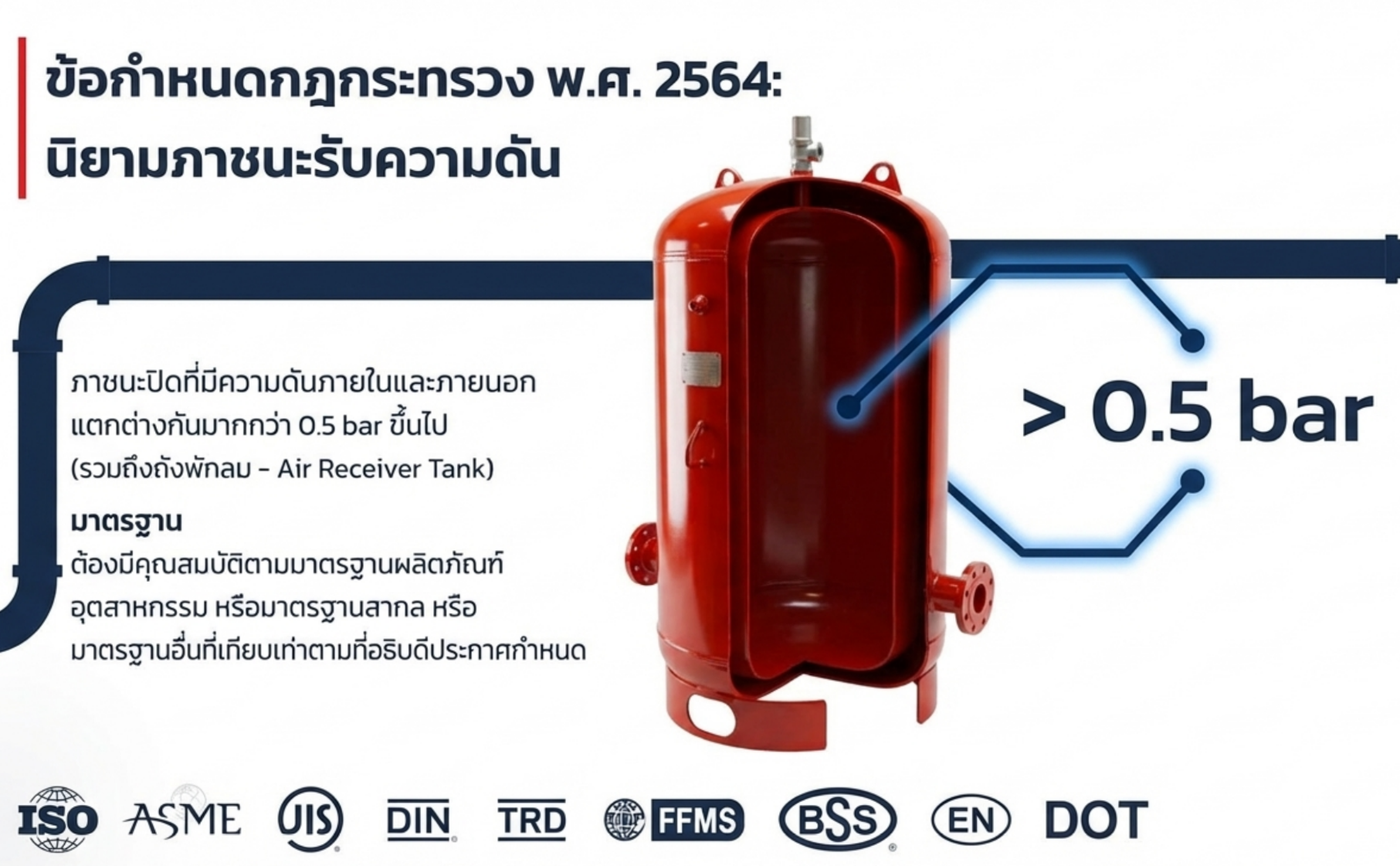
Case 1 and Case 2 are examples of air receiver tank inspection requirements.
Case 1: Large Tank / High Pressure
Conditions: Tank capacity of 1,000 liters or more, or pressure of 5 bar or higher
Must be tested according to the specified intervals and methods detailed in the technical specifications and operation manual
If such documentation is not available, the employer must appoint an engineer to prepare the technical specifications and operation manual in writing
Case 2: Small Tank / Low Pressure
Conditions: Tank capacity less than 1,000 liters, or pressure lower than 5 bar
Must undergo regular visual inspection
Tank thickness must be measured at least once every 5 years for safety
Testing and Inspection Procedures
- Sketch Tank Drawing & Dimension Testing: Preparation of tank drawings and verification of dimensions
- Visual Testing: Inspection of paint condition, corrosion, and leakage by visual examination
- Ultrasonic Thickness Testing: Measurement of shell and wall thickness at sufficient points to assess structural integrity
- Safety Valve Testing: Testing to verify proper operation of the safety valve
- Hydrostatic Testing: Testing to ensure the equipment can operate safely under actual pressure conditions, using water pressure at no less than 1.1–1.5 times the design pressure (for newly constructed tanks, major repairs, or tanks in service for more than 5 years)
- Service Leak Testing: Check for leaks during actual operation to ensure reliability.
- Gasket Replacement: Replace gaskets if damaged and clean the testing area.
- Housekeeping
- Preparation of Documentation and User Manual: Compile design data, thickness calculation, installation requirements, maintenance, and inspection in compliance with regulations.
- Preparation of Test Report (Certification): Evaluate remaining service life, verified by an API 510 Inspector, professional engineer, and certified company authorized by the Engineering Council.